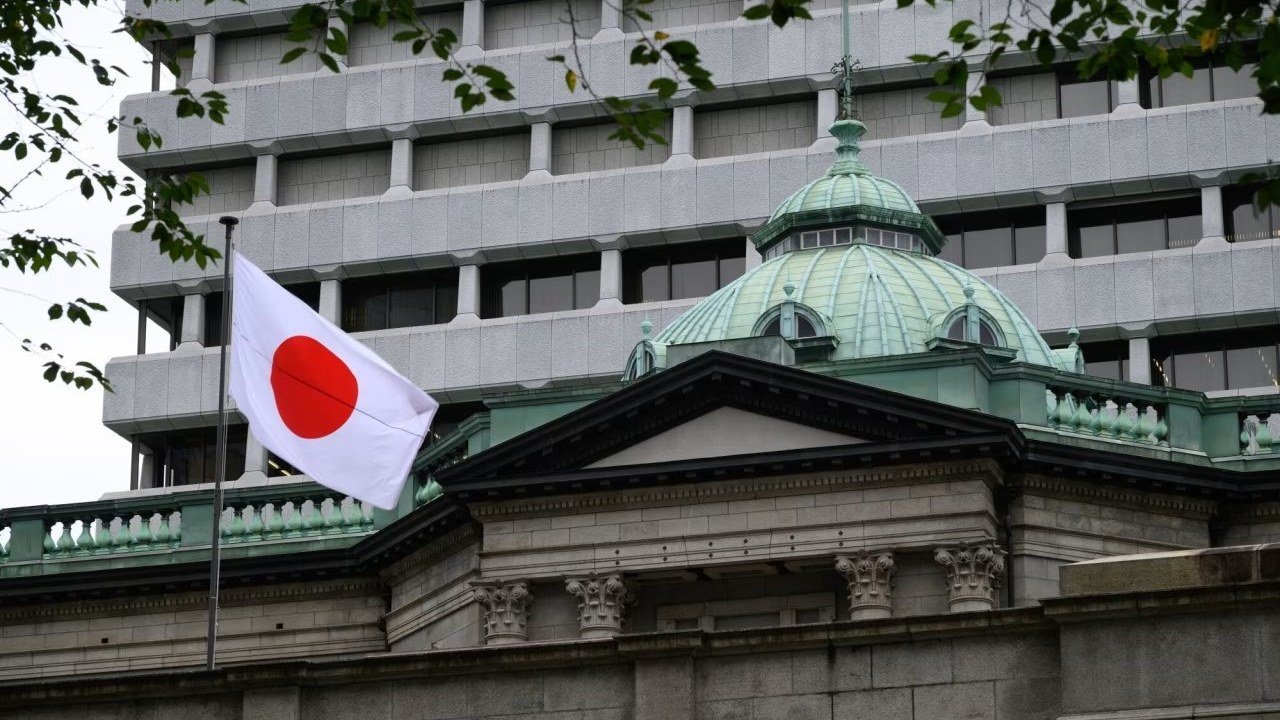
The Bank of Japan left its main interest rate unchanged on Friday, Oct. 30, but changed the way it describes Japanese inflation in a shift that Reuters calls a declaration of “victory in a nearly 14-year battle to hit its price target” (Reuters). In a statement released at 12:02 p.m. in Tokyo (8:02 p.m. PT on Thursday), the Policy Board said it would encourage the uncollateralized overnight call rate “to remain at around 1.25 percent,” in an 8-1 vote (BOJ statement). CNBC reports that the rate stays at its highest level since 1995 (CNBC).
The new wording came in the bank’s quarterly outlook report. “Underlying CPI inflation is at a level that is generally consistent with the price stability target of 2 percent, and is expected to remain at around that level,” the report’s summary says (BOJ outlook). According to CNBC, the bank has never made that assessment since it adopted the 2% target in 2013; before Friday, it used to describe underlying inflation as “approaching 2 percent” (CNBC). Reuters quotes the report as saying “it will be important to examine the degree to which underlying inflation is anchored around 2%” (Reuters).
Governor Kazuo Ueda tied the hold to a wish for more time. “We saw the need to scrutinise a bit more economic and price risks, as well as financial conditions. But underlying inflation has reached levels consistent with our price target,” he told a news conference after the decision, according to a Reuters translation. “Financial conditions remain accommodative. There are various upside risks. We must therefore be vigilant to the risk of inflation overshooting our target” (Reuters; Reuters excerpts). He also cautioned against reading Friday’s words as a finish line: “Our goal is to sustainably and stably achieve our price target. In that sense, we haven’t reached our goal yet,” he said, adding: “That doesn’t mean we will just sit and wait” (Reuters excerpts).
Watch: Ueda’s news conference, via @aoi_fxtrader_ on X
A short clip posted on X during the governor’s news conference. If the embed does not load, it shows as a plain link to the original post.
View the @aoi_fxtrader_ post on X: Ueda news conference clip
One board member wanted to move now. Hajime Takata voted against the hold and proposed raising the rate to around 1.5 percent; his proposal lost by a majority vote, the statement says. In the bank’s summary of his view, Takata considered that, with underlying inflation at the target, “the situation had shifted to a new phase in which the Bank needs to step up the pace of bringing the policy interest rate closer to the neutral interest rate” (BOJ statement). Ueda and the other seven members present, including both deputy governors, voted for the hold, according to the statement (BOJ statement).
The board also raised some of its price forecasts. The median forecast for core consumer prices, which exclude fresh food, now stands at 2.5% for the fiscal year ending in March 2027, 2.6% for the following year (up from 2.4% in July) and 2.0% for fiscal 2028, the outlook report shows. For prices that also exclude energy, the medians read 2.4%, 2.7% and 2.3%. Growth forecasts sit at 0.7%, 0.7% and 0.8% (BOJ outlook). The report calls the risks to prices “skewed to the upside” and names the Middle East, AI-related demand and foreign exchange rates among the main uncertainties; the bank notes that its figures leave out the effect of a proposed cut in the consumption tax on food and beverages (BOJ outlook).
In a step that Reuters calls a surprise, the board voted unanimously to sell its holdings of exchange-traded funds faster (Reuters; BOJ statement). The bank began selling ETFs in January 2026 at about 330 billion yen a year, measured at book value, roughly 0.05% of market trading value. From January 2027, it will sell at about 0.1% of trading value, or about 860 billion yen a year at book value, the statement says, adding that the new pace converts to about 2,460 billion yen at market value (BOJ statement). Reuters puts the new figure at $5.45 billion (Reuters). The bank keeps the option of a temporary adjustment or suspension “in response to changes in financial market conditions” (BOJ statement).
Markets moved, but other forces drove most of the moves. The yen rose to a high of 157.115 per dollar after the decision and later gave up those gains to trade at 157.67, CNA reports, carrying Reuters copy (CNA/Reuters). Shuhei Uehara, a currency analyst at Gaitame.com Research Institute, linked the brief rise to the higher inflation forecast and to the dissent, according to the same report (CNA/Reuters). Tokyo’s Nikkei average closed down 2.1% at 63,290.11 after a drop of as much as 3%, led by chip stocks amid doubts about AI spending; the market “was largely unmoved” by the ETF news, CNA reports (CNA/Reuters).
Analysts read the hold as a pause before another hike. Krishna Bhimavarapu, an Asia-Pacific economist at State Street Investment Management, called it a “hawkish hold,” CNBC reports, and said the bank expects to reach the target through a “self-sustaining wage-price-consumption cycle”; he added that Japan’s growth does not justify rushing the next move (CNBC). Most analysts in a Reuters poll expect a rise to 1.5% in December, with an end point around 1.75% to 2% (Reuters). In a CNBC survey of 16 economists before the decision, all expected the bank to set up a hike in December or January, and 13 expected rates to peak at 1.75% to 2% by around mid-2027 (CNBC).
The shift follows two hikes this year. The BOJ raised rates in June and again in September, a faster rhythm than its roughly twice-a-year moves in 2024 and 2025, Reuters reports, as high energy costs and a weak yen pushed up prices (Reuters). Core inflation reached 2.1% in September, its highest level this year, and inflation-adjusted wages rose for an eighth straight month in August, up 1.5% from a year earlier, CNBC reports; experts told CNBC that energy subsidies from Prime Minister Sanae Takaichi’s government hold the price figures down (CNBC). Finance Minister Satsuki Katayama reportedly told parliament this month that Japan stood “on the cusp of shifting to a period of sustained inflation driven by rising wages,” CNBC reports (CNBC).
Reuters frames Friday’s language as a turning point for a central bank that has spent most of its history since gaining independence in 1998 fighting low or falling prices. Under former governor Haruhiko Kuroda, the bank launched massive stimulus in 2013 to reach 2% inflation, and it ended that mix of unorthodox steps in 2024, Reuters reports (Reuters). Rising prices could still weigh on spending by households, “many of whom have never experienced widespread price gains in their lifetime,” the agency adds (Reuters). The BOJ plans to publish the full outlook report on Nov. 2 and a summary of board opinions on Nov. 10, according to the statement (BOJ statement). The decision closed a week in which the U.S. Federal Reserve also held rates (Seems News, Fed hold).