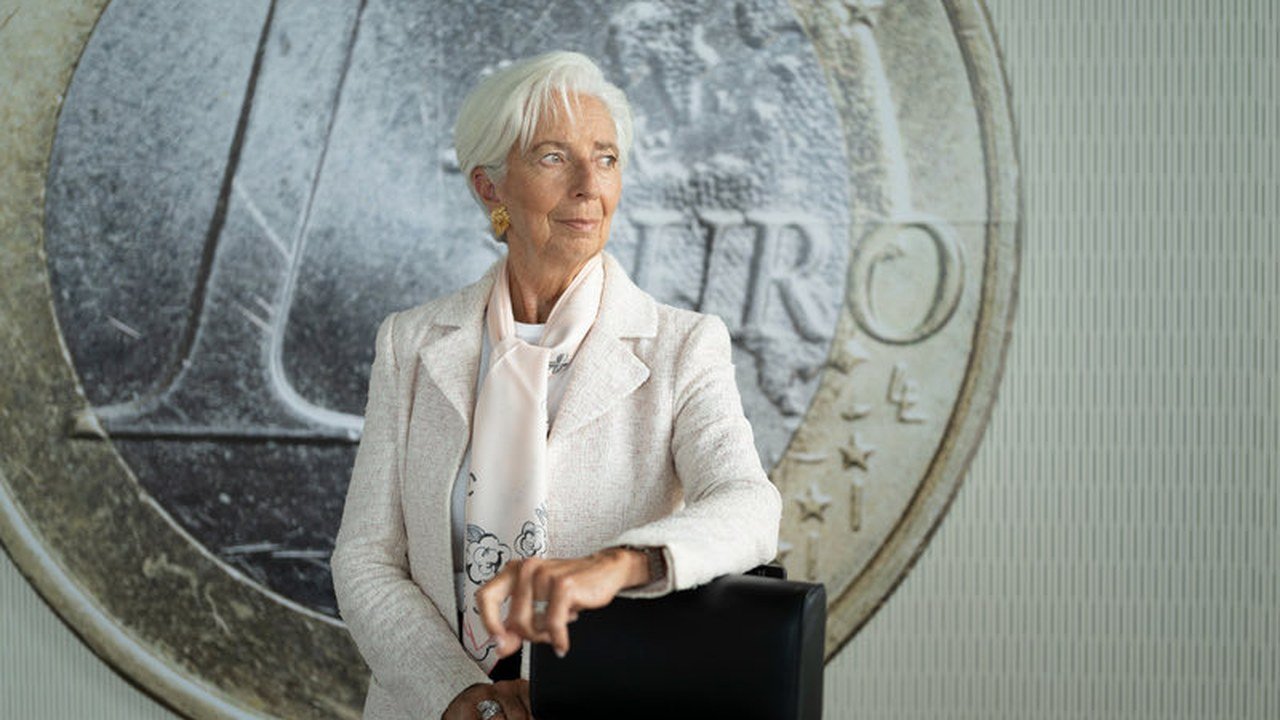
Christine Lagarde will leave the presidency of the European Central Bank on Feb. 7, 2027, the bank announced on Thursday, Oct. 29. “European Central Bank President Christine Lagarde today informed the Governing Council and the President of the European Council António Costa that she will step down from her position on 7 February 2027,” the ECB said in a three-sentence release from Frankfurt (ECB). The bank posted the news on X at 3:00 a.m. PT (@ecb on X). According to the release, “The Governing Council thanked President Lagarde warmly and gave her a long standing ovation” (ECB).
Minutes later, Lagarde posted a 45-second video on her own X account. “I have just informed my colleagues that I will step down as @ECB President on 7 February 2027,” she wrote with it. “It has been a source of great pride to serve this institution. I thank all of those who have supported me on this journey over the past seven years” (@Lagarde on X). In a second post she added, “Just to avoid any social media chatter: the plasters on my face are due to a small surgery earlier in the week” (@Lagarde on X).
Watch: Lagarde’s own statement, via X
This desk viewed a still from the clip before embedding it. If the embed does not load, it shows as a plain link.
View the @Lagarde post on X
The timing leaves about nine months of her eight-year term unused. Reuters reports that the term “was scheduled to run until the end of October 2027” and that speculation about an early exit “had been mounting for months, with the World Economic Forum seen as a likely destination” (Reuters). The ECB itself gave no reason for her departure, Euronews notes (Euronews). The Financial Times, in a report carried by The Irish Times, says Lagarde “has been in talks to chair the World Economic Forum” (FT via The Irish Times).
That link has a paper trail. On Oct. 15, Reuters reported that the forum’s Board of Trustees, which includes Lagarde herself, could elect her as its next chair at a meeting on Nov. 2, citing four people close to the organization; those people said at the time that no final decision had come (Reuters, Oct. 15). The same report quoted a fifth person as saying that Lagarde’s wish to give French President Emmanuel Macron a say on her successor counted as one factor in the timing, and it described concern in European political circles that the talks could grow harder if far-right leader Marine Le Pen won France’s spring presidential election (Reuters, Oct. 15). Neither the ECB nor Lagarde has confirmed any next job; the ECB declined to comment for that Oct. 15 report (Reuters, Oct. 15).
European Council President António Costa responded within minutes. “I respectfully acknowledge her decision,” he said in a statement, and thanked “Madame Lagarde for her dedication as President of the ECB since November 2019” (European Council; @eucopresident on X). He credited her with “a steady and determined stewardship, helping to safeguard stability and the resilience of the euro area” through “a global pandemic, a war in Europe, energy crises and inflation shocks” (European Council).
Costa also set the clock running on the succession. “To ensure a smooth transition to the next leadership of the ECB, the process for the appointment of her successor will be initiated today and will proceed without delay,” he said, with a decision by the European Council “acting in its euro area composition” under Article 283(2) of the Treaty on the Functioning of the European Union (European Council). Euronews explains that under EU rules leaders appoint the president by qualified majority, after a recommendation from EU finance ministers and consultations with the European Parliament and the ECB’s Governing Council (Euronews). The FT adds that any new executive board member needs the support of at least 16 of the 21 countries that use the euro, representing 65% of the bloc’s population (FT via The Irish Times). Investing.com reports that European leaders hold summits in November and December where they will try to choose (Investing.com).
Two names lead the reported field. The Dutch government backs Klaas Knot, the former governor of the Dutch central bank, and Spain backs Pablo Hernández de Cos, general manager of the Bank for International Settlements and a former governor of the Bank of Spain, according to the FT (FT via The Irish Times). Reuters reported on Oct. 15 that France appeared to target the chief economist’s post instead (Reuters, Oct. 15).
The presidency forms part of a wider reshuffle. Executive board member Isabel Schnabel will leave a year early, in January, to take a senior post at the International Monetary Fund, and chief economist Philip Lane’s term expires in May, the FT reports (FT via The Irish Times). Reuters reported earlier this month that EU officials said the three appointments could come as part of a package deal among member states (Reuters, Oct. 15).
The announcement landed on a rate-decision day. The ECB planned to publish its interest-rate decision at 13:15 GMT (6:15 a.m. PT) on Thursday, followed by Lagarde’s regular press conference at 13:45 GMT (6:45 a.m. PT), Reuters reports (Reuters). Euronews says markets widely expect the bank to keep its deposit rate at 2.5% (Euronews), and CNBC reports that a hold looks likely even though euro-zone inflation hit a three-year high in September (CNBC). Investing.com notes that the ECB raised borrowing costs in June and September and links the current inflation pressure to the Iran war (Investing.com). This desk covered the Federal Reserve’s own decision to hold rates on Oct. 28 (Seems News, the Fed).
Lagarde, a former French finance minister and managing director of the IMF, took office at the ECB in November 2019, succeeding Mario Draghi (Euronews; Investing.com). In 2007, CNBC notes, she became the first woman to serve as finance minister of a G7 country (CNBC). The FT writes that her tenure took shape around “the worst pandemic in a century, the bloodiest war in Europe since 1945, the biggest inflation shock in a generation and a trade war with the US”; CNBC says the energy price shocks sent euro-area inflation above 11% (FT via The Irish Times; CNBC).
She becomes only the second ECB president to leave early. The first, Wim Duisenberg of the Netherlands, left after five years under a political understanding reached at the start of the monetary union, the FT reports (FT via The Irish Times); Investing.com describes that shortened term as a deal agreed in advance to resolve a deadlock between France and Germany (Investing.com). Earlier this year, according to the FT, Lagarde said she had expected to serve five years rather than eight when she agreed with Macron to take the job (FT via The Irish Times).