Severe Cyclonic Storm Murasu came ashore on India’s east coast early Tuesday, Nov. 3, crossing the south Andhra Pradesh coast close to the city of Ongole in Prakasam district. The India Meteorological Department (IMD) posted on X at 6:36 a.m. India time (5:06 p.m. PT Monday) that the storm “moved north-northwestwards and crossed the south Andhra Pradesh coast between Nellore and Narsapur, close to Ongole (near Latitude 15.53°N and Longitude 80.22°E) during 0330 to 0530 hours IST of today, with wind speed of 100-110 kmph gusting to 120 kmph.” That window corresponds to 2 to 4 p.m. PT on Monday. Murasu reached land as the second cyclone to hit the region in a week, according to Reuters, as published by Aaj English TV.
Early reports describe broad damage but no confirmed deaths. No deaths or injuries had come to light, though some trees and electric poles came down, Reuters reported, citing Prakhar Jain, managing director of the Andhra Pradesh State Disaster Management Authority. Mohsen Shahedi, a deputy inspector general of the National Disaster Response Force (NDRF), said: “As per the information available with us so far, there has been no loss of life,” according to The Daily Jagran. Those statements reflect the first hours after landfall, and officials had not published a final damage count by the time this desk checked.
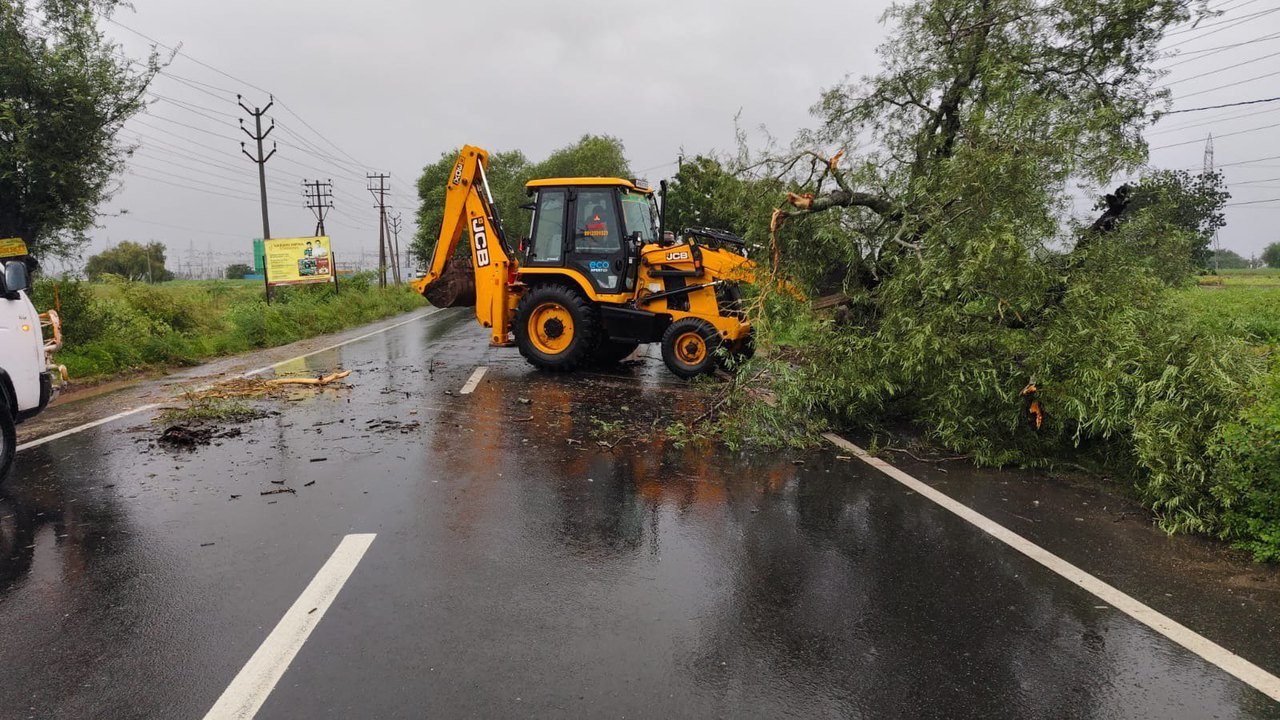
Press Trust of India (PTI) reports carried by The New Indian Express and India Today said the storm uprooted thousands of trees, damaged hundreds of electric poles and wrecked fishing boats, while heavy rain flooded several localities and damaged standing crops. Prakasam, Bapatla, Palnadu and Guntur districts “bore the brunt of the storm,” according to The New Indian Express. Vehicles sat stranded on national highways as rain and wind cut visibility, the same report said. An ANI video posted on X at 12:25 a.m. PT Tuesday said salt pans and farm fields in and around Ongole “have suffered extensive damage.”
Residents of fishing villages described the night. “This is the most dangerous cyclone we have witnessed in the last 14 years. The government has been very helpful and evacuated around 400 families from our village. NDRF teams also helped us shift to safer places,” Krishnamma, a fisherman from Kothapatnam in Prakasam district, told PTI, according to The New Indian Express. Another resident, Mangamma, said she had lost her house in an earlier storm. “This time, the government evacuated us before the cyclone made the landfall. However, one of my three boats has been completely destroyed. Fishing is our livelihood,” she said, according to India Today.
The rain totals ran high along the coast. Bapatla recorded 222.4 mm (about 8.8 inches) in the 24 hours ending 8:30 a.m. Tuesday India time, the highest among the reported stations, followed by Narasapur at 198.6 mm and Ongole at 120.2 mm, according to India Today. Kothapatnam, a coastal village in Prakasam district, logged 16.4 cm between 8:30 a.m. Monday and 5 a.m. Tuesday, The New Indian Express reported. Before landfall, IMD had warned of a storm surge of 1 to 1.5 meters above the astronomical tide in parts of Bapatla, Krishna and Prakasam districts, according to the same report.
State officials report a large relief effort. An official release said Murasu caused “abnormal impact” over 132 mandals (local administrative blocks) in 15 districts, that 10,805 people went to cyclone shelters, and that the state set up 171 relief camps and handed out 14,810 food packets, according to PTI as published by DTNext. The same release said 11 NDRF and 13 state disaster response teams deployed, along with 185 fire department teams clearing fallen trees, and that 3,066 pregnant women and 1,008 nursing mothers moved to hospitals as a precaution. A PTI video on X posted at 12:50 a.m. PT showed NDRF teams clearing roads blocked by uprooted trees in Chirala.
Watch: crews clear roads and fields show damage after Cyclone Murasu, posted on X
If an embed does not load, it shows as a plain link to the original post.
View the @PTI_News post on X
View the @ANI post on X
Chief Minister N. Chandrababu Naidu held a teleconference with senior officials and district collectors early Tuesday and told them to prioritize drinking water, electricity and road connectivity while treating the prevention of deaths as the foremost concern, according to India Today and The Hindu. Officials told him that power had returned in parts of Palnadu, Markapuram and Guntur districts, and Naidu ordered faster restoration in Prakasam and Bapatla, according to India Today. The state had sent 31,000 electricity poles into the field, about 1,000 personnel from Chennai headed in, and Karnataka pledged 500 skilled electricity workers to help restore power, the same report said. Naidu posted on X at 12:20 a.m. PT Tuesday, with photos of crews at work: “From clearing roads to rescuing families, your bravery on the ground is saving lives.”
Travel took a hit before the storm arrived. At least 19 domestic flights got canceled on Monday at Vijayawada, Tirupati and Visakhapatnam airports, according to India Today, while Hindustan Times counted at least 30 cancellations on Monday once Chennai joined that list, and nine trains canceled as a precaution. Schools and colleges closed in at least eight districts, according to DW. Neighboring Odisha had moved more than 160,000 people to safer places across five southern districts, according to India Today and Hindustan Times, though parts of that state reported only light rain as the cyclone crossed Andhra Pradesh.
What comes next depends on how fast Murasu loses strength inland. IMD’s advisory issued at 11:30 a.m. India time placed the storm about 30 km north-northeast of Ongole and 100 km south-southwest of Vijayawada, moving north-northwest at 8 km/h, and forecast weakening into a cyclonic storm with winds of 80 to 90 km/h by midday and into a deep depression with winds of 55 to 65 km/h by late Tuesday night India time. Heavy spells of rain remained likely over south coastal Andhra Pradesh, according to The Hindu, Hindustan Times reported that Telangana expected heavy rain as the system moves inland, and IMD forecast heavy to very heavy rain in parts of Tamil Nadu, according to India Today. For this desk’s pre-landfall forecast report, see Seems News’ earlier story; for last week’s storm, see the Cyclone Arnab report.