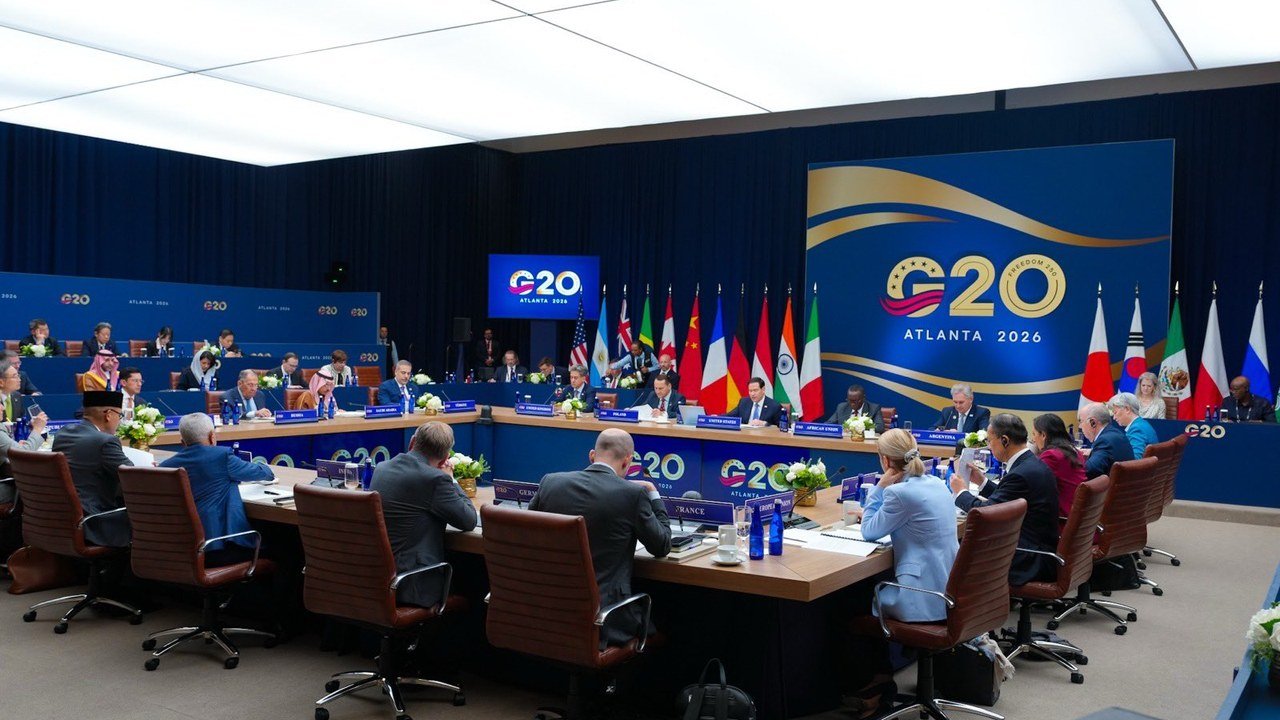
The top diplomats of the Group of 20 largest economies wrapped up two days of talks in Atlanta on Saturday, Oct. 31, without agreeing on a joint communique, according to the Associated Press, whose report PBS NewsHour and CNBC carried, and China’s Xinhua news agency. Divisions, “notably over Russia’s war with Ukraine, visibly overshadowed the start of the Atlanta meeting and impacted its outcome, too,” the AP reports. In place of a communique, Secretary of State Marco Rubio, who chaired the meeting, released a chair’s statement after the sessions closed, the AP says. Xinhua describes the participants as having “failed to reach consensus on major global geopolitical and economic security issues amid the Ukraine crisis and the U.S.-Iran conflict.”
The chair’s statement, posted by the University of Toronto’s G20 Research Group with the State Department named as its source, says the ministers “held candid discussions on the U.S. priorities,” naming energy security, supply chain resilience and “geopolitical tensions, including the Straits of Hormuz and the Bab al-Mandab.” It argues that “abundant energy is the backbone of a booming economy,” calls for “safe navigation and transit passage through international waterways,” and says trade in food “should not be used as a tool for economic or political coercion.” It also credits $2 billion raised at a September event in New York with spurring the response to Ebola. The AP notes that the statement “made no mention of any agreements reached” and instead lists priorities that members judged important to solve.
At his closing news conference, Rubio acknowledged the gap. “I wouldn’t pretend to you today that we are close to finding universally accepted solutions to these problems,” he said, according to the AP and the State Department transcript, adding that “among the G-20 represented here are countries that are working together to solve some of them, particularly in the realm of supply chains and critical minerals.” Earlier in his remarks he described nations as arguing over “what are the causes that are creating those problems” and “how to solve them,” and said the first step lay in “some universal acknowledgment that freedom of navigation matters, that critical minerals matter, that supply chains matter, that food security matters,” according to the transcript. In a post on X on Saturday morning, Rubio wrote that he had told partners “secure supply chains are essential for growth” and that the Strait of Hormuz and the Bab al-Mandeb Strait “must remain secure and open to commerce.”
Watch: Rubio opens the talks, then takes questions at the close, via posts on X
Both clips come from the State Department’s official account. If an embed does not load, it shows as a plain link to the original post.
View the @StateDept post on X with Rubio’s opening remarks
View the @StateDept post on X with Rubio’s full closing news conference
The rift showed on the first day. Rubio opened the talks on Friday with an appeal for unity but then canceled the traditional group photo of the foreign ministers after European diplomats objected to the inclusion of Russian Foreign Minister Sergey Lavrov and threatened to boycott or walk out of the picture, the AP reports. A diplomatic source told AFP that some European officials declined to appear beside Lavrov, according to The Straits Times, which carries the AFP report; a U.S. official told AFP that organizers called off the photo to avoid allowing “a ceremonial photo opportunity to become a diplomatic distraction.” Xinhua adds that representatives from Australia and Canada reportedly also opposed posing with Lavrov.
European officials used the meeting to confront the Russian minister. EU foreign policy chief Kaja Kallas told AFP that “we were able to address Sergei Lavrov head-on” over the war in Ukraine and that “he put forward a lot of lies, a lot of false narratives that we were also able to then rebuke,” according to The Straits Times. “They should show with their deeds that they are ready to negotiate, but they are clearly, clearly not,” Kallas said, the same report says. In a post on X on Friday, Kallas wrote that she had called in Atlanta for “a Black Sea freedom of navigation arrangement.” British Foreign Minister Ed Miliband said he told Lavrov in the plenary that “he should have the courage to tell Putin that Russia will not win this war,” according to Euronews.
Lavrov offered his own reading. In a post on Friday, Russia’s foreign ministry quoted him on X as saying that “the US willingness & interest in dialogue can only be welcomed” and calling that “a good lesson for our European colleagues, who continue to maintain a stance of arrogant boycott.” He also said Moscow would not allow a situation in which Ukraine poses a “military threat to legitimate security interests of the Russian Federation,” the AP reports. Participants who spoke to the AP on condition of anonymity described the opening session as cordial but said Russia’s position on Ukraine stayed unyielding, as did its opposition to Poland’s membership in the G20. A European diplomatic source told AFP that Lavrov came across as “quite provocative” in his remarks, Ukrinform reports; Lavrov himself called his brief sideline conversation with Rubio “decent,” the same report says.
Rubio defended the decision to invite Lavrov, and to invite Putin to the leaders’ summit. “In order to end the war in Ukraine peacefully, you’re going to have to have a negotiated settlement,” he said, according to the State Department transcript, which renders his words without apostrophes; this desk restored them. “How can you have a negotiated settlement between Russia and Ukraine if you don’t have the ability to talk to both Russia and Ukraine?” He also cited Russia’s nuclear arsenal, saying contact matters “because of the danger of escalation in the future if, God forbid, something were to go wrong.” Yet he sounded cautious about the result: “I don’t know if a negotiated peace is achievable in Ukraine. That’s what we’re trying to find out,” the transcript shows. He said he did not know whether Putin would come to Miami, and Xinhua reports Rubio said Russia had not confirmed. The leaders’ summit takes place in December at Trump’s Miami golf club, the AP reports.
Poland marked another fault line. Polish Foreign Minister Radosław Sikorski, attending a G20 meeting as a guest for the first time, said he felt no surprise at the lack of consensus: “We have wars going on, and we have participants in those wars around the table, so it’s very difficult to agree on a common line,” according to the AP. Rubio singled out the Polish delegation and said that “President Trump believes very strongly that Poland deserves a seat at this table of global leaders,” the transcript shows. The diplomats who spoke to the AP also listed the Trump administration’s decision not to invite G20 member South Africa, over the objections of others, among the disagreements; Xinhua notes that South Africa held the group’s rotating presidency last year.
Beyond Ukraine, the AP’s anonymous sources said a chair’s statement “had long been the plan” because of deep differences over the U.S.-Israeli war against Iran, U.S. tariffs and Chinese moves in the South China Sea, all of which have pushed up fuel costs and clouded trade, according to the AP. The AP has also reported that U.S. officials told several Middle East countries and regional allies to prepare for potential renewed strikes against Iran after the U.S. elections on Tuesday, Nov. 3, and Xinhua reports that participants voiced concern over that possibility. On shipping through Hormuz, Rubio told reporters that “so far we’ve had some very limited cooperation but not much; it primarily has fallen on the United States to protect shipping,” according to the transcript. China’s Vice Foreign Minister Ma Zhaoxu urged the G20 to “shoulder its due responsibilities” for peace and stability, Xinhua reports.
Even close partners showed gaps. On Saturday Rubio hosted talks with his counterparts from Australia, India and Japan, the Quad group, before leading the final G20 session on freedom of navigation in the Strait of Hormuz and the Red, Black and South China seas, the AP reports. The joint statement from that meeting referred six times to “Super Intelligence (SI),” each with an asterisk leading to a footnote that in Australia, India and Japan the term refers to artificial intelligence, according to the AP, which adds that no other country has followed Trump’s renaming of the technology. Separately, the State Department announced on Friday that it had approved a proposed $2.1 billion sale of Patriot air defense interceptors for Ukraine, the AP reports.
What comes next: the ministers’ talks served as groundwork for the leaders’ summit in Miami in December, and the chair’s statement says the U.S. presidency looks forward to that summit and to the United Kingdom’s presidency in 2027, according to the statement. Other participants told the AP that all had agreed to try to overcome their differences and work to make the summit a success. Ukrinform reports the summit dates as Dec. 14–15, and fresh negotiations between Kyiv, Moscow and Washington appear due in November, according to AFP via The Straits Times. This desk will update this report if the State Department publishes further outcome documents from Atlanta.