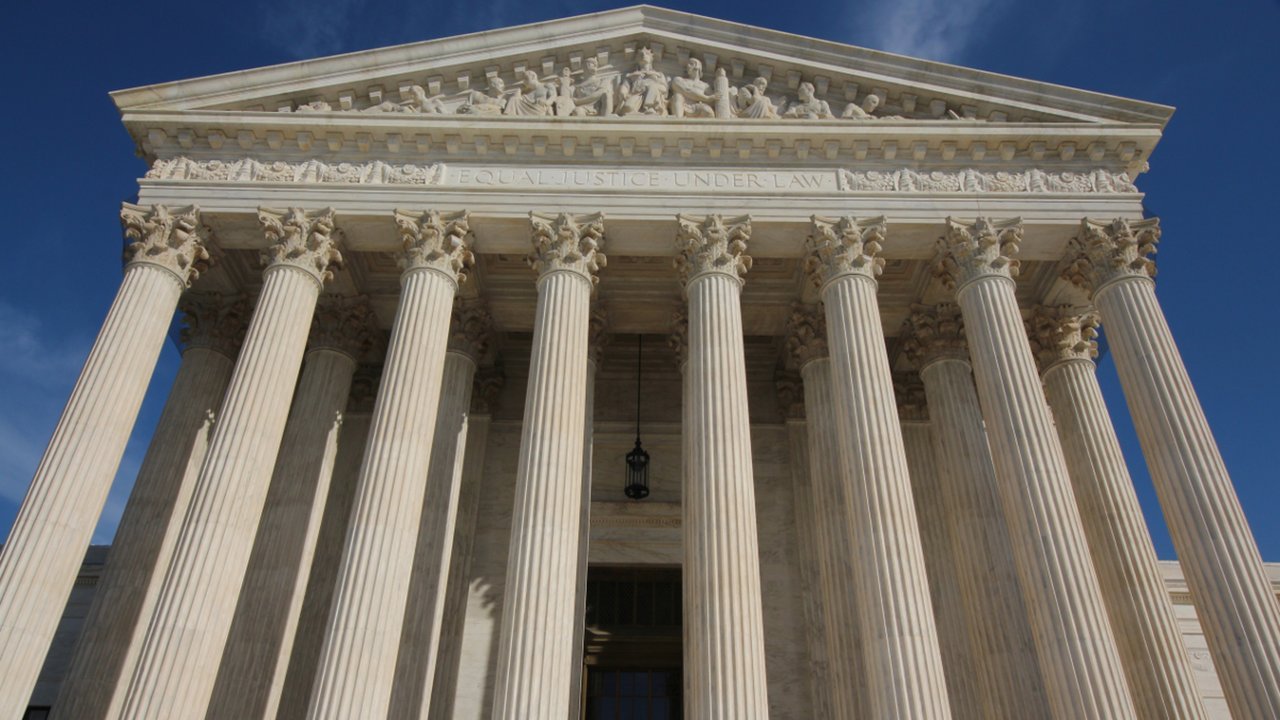
The Supreme Court on Wednesday, October 14, freed the Federal Communications Commission from a court-ordered deadline to rule on whether political parties may keep buying broadcast ads at the discounted rates federal law sets for candidates, according to the court’s unsigned per curiam opinion in FCC v. Brown. The opinion stays an October 7 order in which a divided panel of the 4th U.S. Circuit Court of Appeals told the FCC to resolve a pending challenge by 12:00 noon on Friday, October 9, which the Supreme Court describes as 48 hours from the entry of that order. Justices Sonia Sotomayor and Ketanji Brown Jackson would deny the applications, the opinion notes; Roll Call adds that neither wrote a dissent. Reuters, the Los Angeles Times and Roll Call say the court sided with Republicans, and Bloomberg Law calls the ruling another win for the Trump administration and Republicans. The earliest reports this desk read came from Reuters, whose copy appeared on SquawkNews at 1:39 PM PT, and Bloomberg Law at 1:41 PM PT; the docket does not list a release time for the opinion.
The fight concerns the “lowest unit charge,” the favorable rate broadcasters must charge candidates for campaign ads in the weeks before an election under 47 U.S.C. §315(b)(1)(A). On March 30, 2026, the FCC’s Media Bureau issued a public notice stating that candidates, joint fundraising committees with noncandidate members and political parties engaged in coordinated political activity qualify for that rate, according to the opinion. SCOTUSblog says the rates apply in the 45 days before a primary and the 60 days before a general election; Reuters says the general-election window opened this year on September 4. Reuters reports that the FCC, chaired by Brendan Carr, whom it calls a Trump ally, and holding a 2–1 Republican majority, made the change in a move seen as a boost to Republicans. The 4th Circuit’s October 7 order says the commission currently has three members, two Republicans and one Democrat, Commissioner Anna Gomez, who dissented from a related Media Bureau ruling on August 25 while criticizing the processes used on the candidates’ application and the notice. In a public statement, Gomez objected to election-year rule changes “forced on them in the dark” with no opportunity for public input, according to the Los Angeles Times and the 4th Circuit order; the two quote her with slightly different wording, the Times writing “The American public” and “the eve of the election,” and the order “[t]he American people” and “the eve of an election.”
Four Democratic candidates challenged the notice: Sen. Jon Ossoff of Georgia, former Sen. Sherrod Brown of Ohio, former Gov. Roy Cooper of North Carolina and Rep. Kristen McDonald Rivet of Michigan, according to SCOTUSblog and the caption of the 4th Circuit’s order. The Los Angeles Times names only the three Senate candidates. They first asked the full commission to review the notice in late April, SCOTUSblog reports, and in early June, with that request still pending, went to the 4th Circuit, which set the notice aside in a divided ruling, the Supreme Court’s opinion says. On September 4 the justices stayed that ruling, saying the 4th Circuit likely lacked jurisdiction while the candidates’ application still sat before the FCC; the September 4 opinion lists Justice Jackson as the lone dissenter, which Reuters describes as an 8–1 ruling.
The candidates then asked the 4th Circuit to order the FCC to act, SCOTUSblog reports. In the October 7 order, Judge Robert King and Judge Wynn wrote that the commission “has endeavored to create from whole cloth a new rule entirely outside the purview of judicial review” and that “our willingness to tolerate the FCC’s delay tactics is at an end,” according to the order, which the FCC filed as an appendix to its Supreme Court application; Reuters quotes the second line. Judge Wilkinson dissented, writing that litigants would want to buy “the majority’s new board game: Make The Supreme Court Say It Twice.” The order notes that the Media Bureau opened a comment period on the candidates’ application on September 15, running through September 30.
Solicitor General D. John Sauer asked the justices to step in on October 8, and Chief Justice John Roberts entered an administrative stay that day and ordered a response by 5 p.m. EDT on Saturday, October 10, the Supreme Court docket shows. SCOTUSblog reports that Sauer told the court the 4th Circuit had “seriously erred in trying to short-circuit the Commission’s deliberations,” and that the National Republican Senatorial Committee and National Republican Congressional Committee filed their own application the same day. In their Saturday filing, the candidates faulted the FCC for what they called “blatant procedural trench warfare to stave off judicial review of an unlawful agency directive until it is too late to matter,” according to both Reuters and SCOTUSblog.
The Supreme Court says each stay factor favors the FCC. “The Communications Act requires the Commission to act on every application it receives, but it does not obligate the Commission to act within a particular timeframe,” the opinion says. It adds that “Our system of separation of powers does not allow the Judiciary to meddle in” the workings of a coordinate branch “in this manner,” and that “the FCC will suffer irreparable harm absent a stay.” On that harm, the court writes: “That the mandamus order requires the FCC to abandon its deliberation process is itself an injury that cannot be remedied after the fact.” The stay runs pending a petition for certiorari, if the FCC timely files one, and terminates automatically if the court denies it; the court denied the Republican committees’ parallel application as moot.
An FCC spokesperson welcomed the result, Reuters reports: “We are pleased the Supreme Court has granted the FCC's stay request. The court's decision is right on the law and avoids the specter of upending the rules for political ads right in the middle of an ongoing election.” This desk found no public statement from the four candidates on the ruling in the reports it read. The nonpartisan Campaign Legal Center, according to the Los Angeles Times, argued that the FCC change stood “contrary to the text and purpose of the federal statute and would effectively grant super PACs an advertising discount.”
Reuters ties the dispute to the parties’ finances. Citing Federal Election Commission disclosures for July and August, it reports that the two Republican committees have exceeded the former national coordinated-spending caps by more than $48 million, after the Supreme Court struck those caps down in June, while their Democratic counterparts exceeded them by just under $4 million. Reuters adds that the three main national Republican committees ended August with about $233 million in cash, against roughly $130 million for their Democratic counterparts, who also carried nearly $18 million in debt. The Los Angeles Times says Democratic candidates raise more money through direct, limited contributions from individuals, while Republicans raise far more through party committees.
Reports frame the result differently. The Los Angeles Times says the justices “upheld the use of the GOP-friendly rule in the midterm election,” but the opinion itself rules only on the deadline order and leaves the notice’s legality unresolved; SCOTUSblog describes the effect as leaving the discounted rates in place with no FCC timetable. Roll Call says the ruling “effectively slows down the court fight for months, likely until long after the elections this fall,” though it also says the order set the 4th Circuit decision aside, where the opinion uses the word stayed. Seems News reading note: the stay, its terms and the vote come straight from the Supreme Court’s record; what the ruling means for the midterm ad market rests on outlet analysis and party claims, so weigh those as forecasts. Watch whether the FCC rules on the candidates’ application before November 3, whether anyone files for certiorari, and how broadcasters price party ads in the final weeks.
